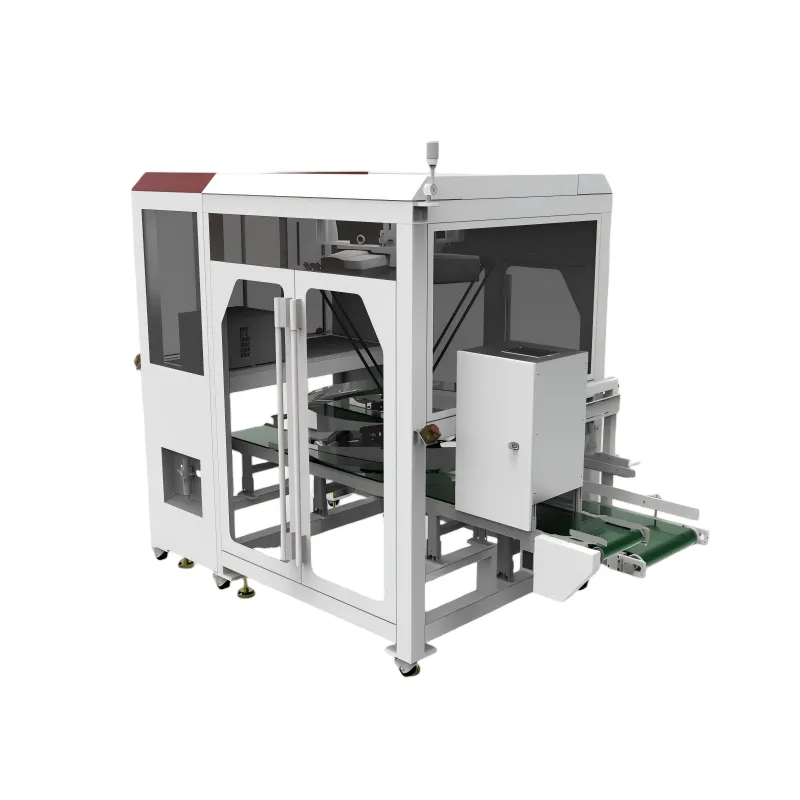
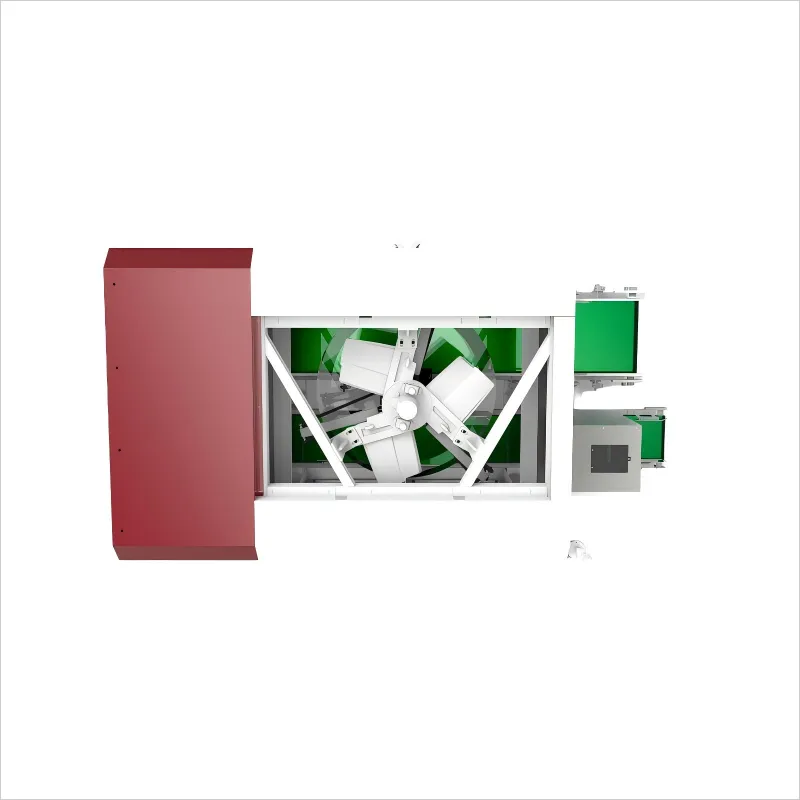
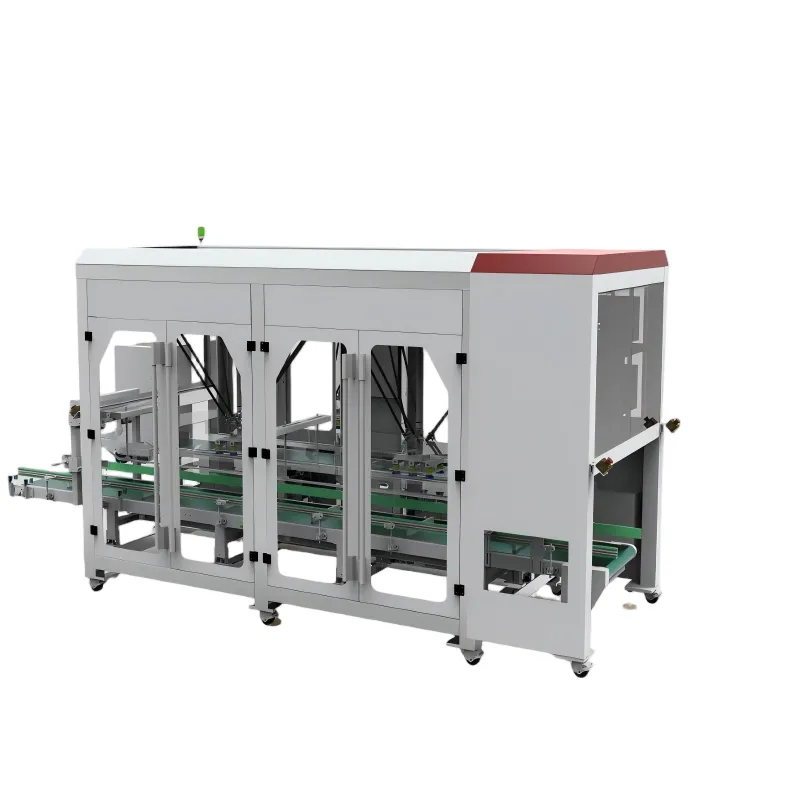
Specifications of RPS-02S Packing Workstation
| RPS-02S Packing workstation |
Model | RPS-02S |
Robot model | BAT800/1100-S3 |
Power supply | Three-phase AC380V±10%, 50/60hz |
Main material | Carbon steel spray/Stainless steel (optional) |
Size | 3245*1680*2400mm |
Power | 4.5kw (It depends on the characteristics of the product) |
Air source | 0.6~0.8MPa |
Packing speed | Maximum 90 times/min |
Work environment | temperature:-10℃~+40℃, humidity:40%~80% |
Machine weight | ≤1300kg |
Applicable product individual weight | ≤2kg |
Applicable carton size | Maximum: 600*400*230mm Minimum: 300*200*150mm (Customization in size range) |
Applicable product category | Small material |
Features of RPS-02S Packing Workstation
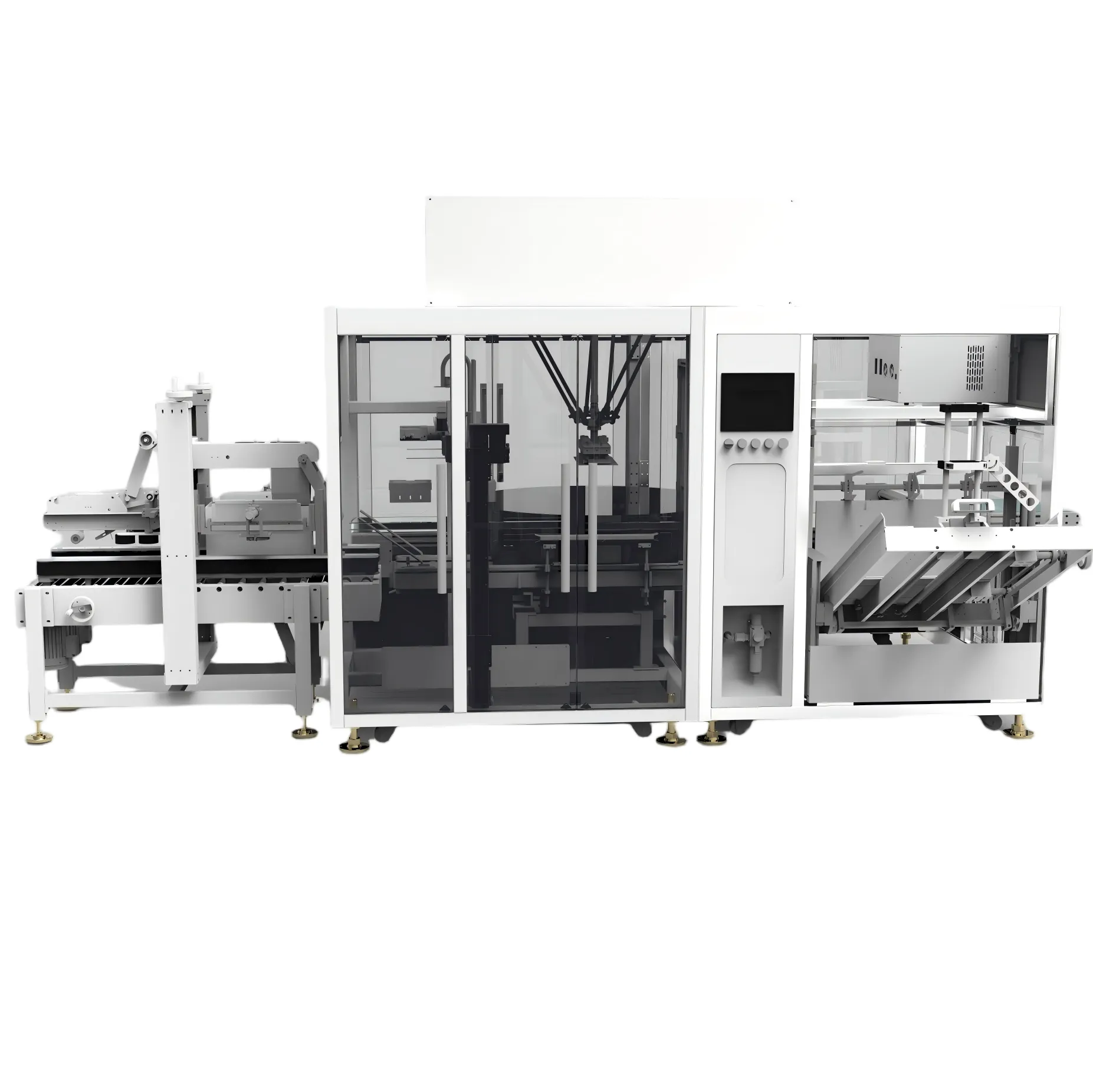
The Tirimi packing workstation features a highly modular design, with flexible assembly and replacement of functional units to quickly adapt to the packing requirements of different product forms, such as bagged and bottled products. The system automatically selects the appropriate feeding and gripping methods based on the product packaging materials (e.g., plastic bottles, soft bags, etc.), enabling seamless switching between “multiple processes on a single platform.”
By replacing different grippers (such as vacuum suction cups, mechanical claws, etc.), the system can seamlessly accommodate products of different specifications and add functions such as partitioning, metering, and rejection according to process requirements.
The entire packaging process is highly automated, completing steps such as feeding, packaging, and sealing without manual intervention, making it suitable for various packaging scenarios in industries such as pharmaceuticals and food.
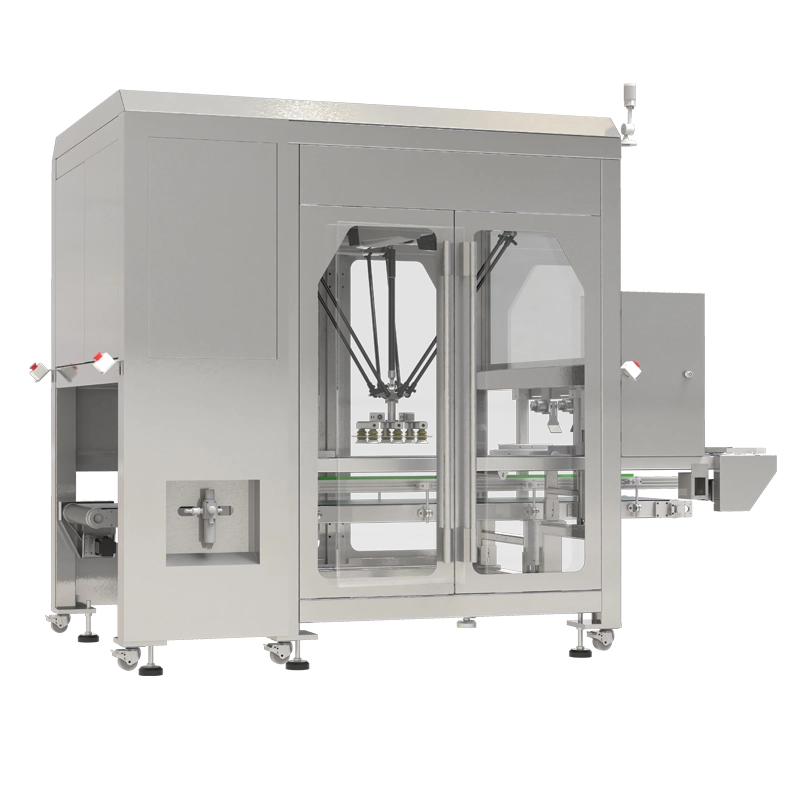
The Tirimi packing workstation integrates advanced vision inspection systems, intelligent grippers, conveyor lines, carton support mechanisms, industrial robots, and other components to achieve fully automated collaborative operations throughout the entire process. The vision system identifies and locates incoming products and carton positions, transmitting precise coordinates to the central control unit; The robotic arm, equipped with interchangeable grippers (such as vacuum cups or mechanical claws), precisely picks up bagged or bottled products after sorting and completes the packing operation. The conveyor belt transports products and cartons to the workstation, with one side feeding products and the other conveying cartons. The carton support mechanism (featuring folding plates and pressure-relief plates) automatically opens the folds of the carton after positioning, providing a smooth pathway for the robot to load the products. The system synchronizes visual and mechanical actions via the central control program: when the image system detects that products and empty boxes are in position, the control system drives the cylinder to move, and the robot picks up the product along the trajectory and places it into the cardboard box. Each subsystem (vision camera, conveyor belt, gripper, cardboard box support, and robot) works in coordination under PLC control to ensure fast and reliable packaging with minimal changeover frequency.
Working Principle of RPS-02S Packing Workstation
The left and right folding support mechanisms function during the folding stage at the bottom of the cardboard box. The left and right folding support blocks (spreader plates) are symmetrically installed on both sides of the cardboard box. When the cardboard box descends to the folding position, the left and right folds of the cardboard box are inserted into the slots on these spreader plates. The rotary cylinder (second fold cylinder) is vertically mounted on one side of the frame and connected to the pivot shaft of the spreader plate via a link (seventh link). When the cylinder extends or retracts, it drives the link to rotate the spreader plate around the shaft. As the spreader plate rotates inward toward the box, it simultaneously folds the left and right flaps of the cardboard box inward until the flaps are parallel to the bottom plate, thereby achieving the spreading of the left and right flaps. To maintain the fold position, guide rods are fixed at the top of the spreader plate, providing downward constraint force to ensure the folds are pressed against the spreader plate and do not spring back.
The front and rear fold support mechanism is responsible for spreading the front and rear folds of the box. This mechanism includes left and right opposing front fold plates and rear fold plates, along with drive components to rotate them. After the carton is positioned in place, the rotary cylinder (first fold cylinder) acts on the front and rear fold plates via a link mechanism, causing them to fold inward. During this process, the pusher rod and connected roller interact with the folds at the bottom of the carton, working with the fold plates to open the front and rear folds; when the folds are opened, the guide plate guides the folds to lie flat, preventing them from springing up or shaking. This design ensures that when the robot picks up the product and places it into the carton, the folding flaps remain in a horizontal position inside the box and do not collide with the gripper. In other words, the rotating cylinder drives the push rods and rollers connected to the front and rear flaps; when the box is clamped, these components swing the front and rear flaps inward to a horizontal position, securely holding them in place while the robot packages the box.
Typical Applications and Value of RPS-02S Packing Workstation
Automation Integration Providers: Tirimi's packing workstations provide automation system integrators with standardized, highly compatible packing modules that can be quickly integrated into entire automated production lines. Modular design, quick-change mechanisms, and standard communication interfaces (such as EtherCAT/Modbus) significantly reduce commissioning time and improve delivery efficiency.
Food Packaging Plants: In high-speed bagged food packaging workshops, Tirimi workstations achieve high-speed, high-frequency picking and automatic packing, capable of handling various packaging forms (such as stand-up pouches, self-standing pouches, and connected pouches). Through vision-based positioning systems and adaptive packing technology, precise and flexible packaging can be achieved without additional sorting equipment.
Pharmaceutical & Daily Chemical Industry: Tirimi workstations are particularly suitable for end-of-line packing operations for bottled pharmaceuticals, health supplements, and daily chemical liquids. Robots precisely control packing angles and force to prevent bottle damage. Combined with flexible grippers and adjustable packing mechanisms, they effectively accommodate various bottle shapes and packaging combinations.
Auto Parts Manufacturers: Suitable for automatic packaging of small and medium-sized parts (such as seals, wiring harnesses, small gears, etc.) after high-frequency feeding. Tirimi can quickly switch between carton sizes and partitioning methods to meet the flexible requirements of rapidly switching between different part types on the same production line.
Value Highlights of RPS-02S Packing Workstation
Flexible Automation: Quickly switch packing parameters to accommodate different carton and product specifications, supporting small-batch, multi-variety production.
Labor Reduction: Robots replace manual carton packing throughout the entire process, significantly reducing operational intensity and the probability of errors.
High Efficiency & Stability: Parallel robots perform high-speed grasping and precise packing, maintaining continuous production line rhythm.
Cost Optimization: Reduce hidden costs caused by labor, downtime, and errors, improving overall return on investment.
Related Single Delta Robot Packing Station