Create Time: 03 ,15 ,2025
Wide Compatibility
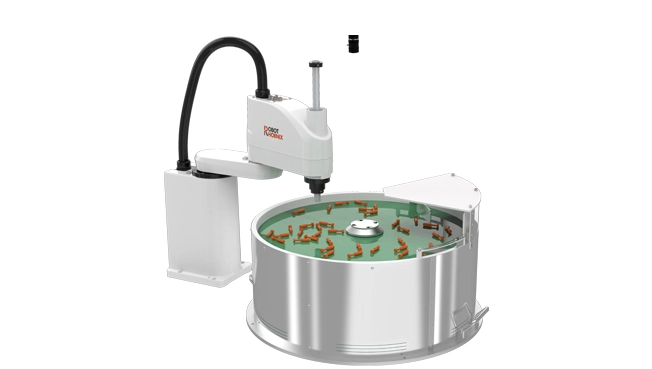
Flexible vibration platforms can easily handle parts with complex geometries, surface coatings prone to scratches, thin sheet parts, and irregularly shaped parts. They address the issues of material jamming and difficult feeding commonly associated with traditional vibration platforms.
Flexibility and Customization
By combining vibration and vision systems, flexible vibration platforms achieve rapid material dispersion, alignment, and precise feeding, making them suitable for multi-variety, small-batch production needs.
High Efficiency and Automation
Flexible vibration platforms work in tandem with robots, significantly improving production efficiency and reducing labor costs. They are an ideal choice for modern intelligent manufacturing.

Handling of Soft Parts
Soft parts such as leads and films: Flexible vibration platforms, through precise vibration control and visual recognition, can effectively handle soft parts that are prone to deformation. Despite irregular deformation postures, they still enable efficient feeding.
Support from vision technology: Integrated with advanced vision systems, flexible vibration platforms can capture the real-time state of parts, optimizing the grabbing and sorting processes.
Handling of Tiny Parts Below 0.5mm
High precision requirements: Equipped with high-precision CCD cameras and vision systems, flexible vibration platforms can accurately identify and grab tiny parts, meeting the production needs of high-precision equipment.
Anti-contamination design: By optimizing vibration frequency and amplitude, the risk of tiny parts being contaminated by dust and dirt during vibration is minimized.
Handling of Easily Tangled Parts
Magnetic parts and other easily tangled parts: Through special vibration modes and separation techniques, flexible vibration platforms can effectively separate easily tangled parts, ensuring a smooth feeding process.
Scenario Comparison
Flexible vibration platforms: Suitable for handling complex shapes, easily damaged or irregularly shaped parts, and ideal for multi-variety, small-batch production.
Conventional vibration platforms: Suitable for handling regularly shaped, non-deformable parts in large batches, with lower costs and mature technology.
Selection Criteria
Material characteristics: Choose the appropriate feeding equipment based on the shape, size, and material of the parts.
Production requirements: Consider production batch size, efficiency requirements, and automation level to select the most cost-effective solution.
Technological advancements: With the progress of vision and vibration control technologies, the application scope of flexible vibration platforms will continue to expand.
Technological Innovation
Engineers are developing more advanced vision systems and vibration control technologies to further enhance the processing capabilities and application range of flexible vibration platforms.
Intelligent Manufacturing
As a core component of flexible feeding systems, flexible vibration platforms will continue to drive production automation and intelligence, helping enterprises improve efficiency, reduce costs, and enhance product quality.
This is the first one.
This is the last one.