Introduction
In today’s fast-paced industrial environment, automatic packing machines play an important role in improving production efficiency, packaging consistency and product handling accuracy. However, greater automation also introduces safety, electrical, mechanical and regulatory responsibilities that manufacturers and equipment users must address.
Compliance is not achieved simply by adding guards or emergency-stop buttons. A compliant automatic packing system should be evaluated throughout its complete lifecycle, including machine design, installation, commissioning, normal production, cleaning, maintenance and foreseeable misuse.
Understanding the applicable regulations and packaging machine safety standards helps businesses protect operators, reduce production risks and prepare equipment for different destination markets.
Overview of Automatic Packing Machine Regulations
Regulatory requirements for automated packaging equipment vary according to the machine configuration, destination country, industry and application. A food packing line, pharmaceutical packaging system and automotive-parts packing workstation may share general machinery-safety principles, but each can also require additional industry-specific controls.
For equipment supplied to the European Union, Machinery Directive 2006/42/EC remains applicable until January 19, 2027. Regulation (EU) 2023/1230 on machinery will apply from January 20, 2027 and will replace the Directive. Manufacturers preparing equipment for the EU market should therefore consider both the current requirements and the upcoming transition.
Depending on the equipment and project scope, compliance may involve:
Risk assessment and risk-reduction documentation
Mechanical guards and access-control measures
Safety-related control functions
Electrical-system protection
Emergency stops and safe restart controls
Technical documentation and operating instructions
Conformity assessment and applicable declarations
Warning labels and residual-risk information
Businesses purchasing an automatic packing machine should confirm which standards and regulations apply to the offered model instead of relying only on general statements such as “CE-ready” or “international standard design.”
Key Standards for Machine Safety and Performance
Several international standards are commonly used when designing and evaluating packing automation systems.
ISO 12100: Risk Assessment and Risk Reduction
ISO 12100 provides the general methodology for identifying machinery hazards, estimating and evaluating risks, and applying suitable risk-reduction measures. It covers risks throughout the machine lifecycle rather than focusing only on normal operation.
For an automatic packing line, the risk assessment should consider hazards associated with:
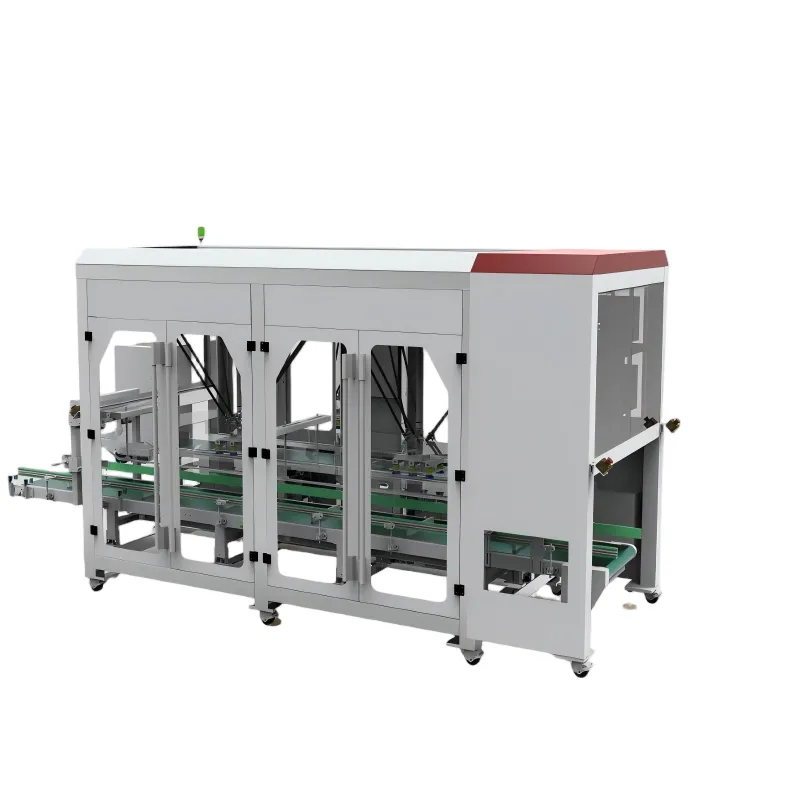
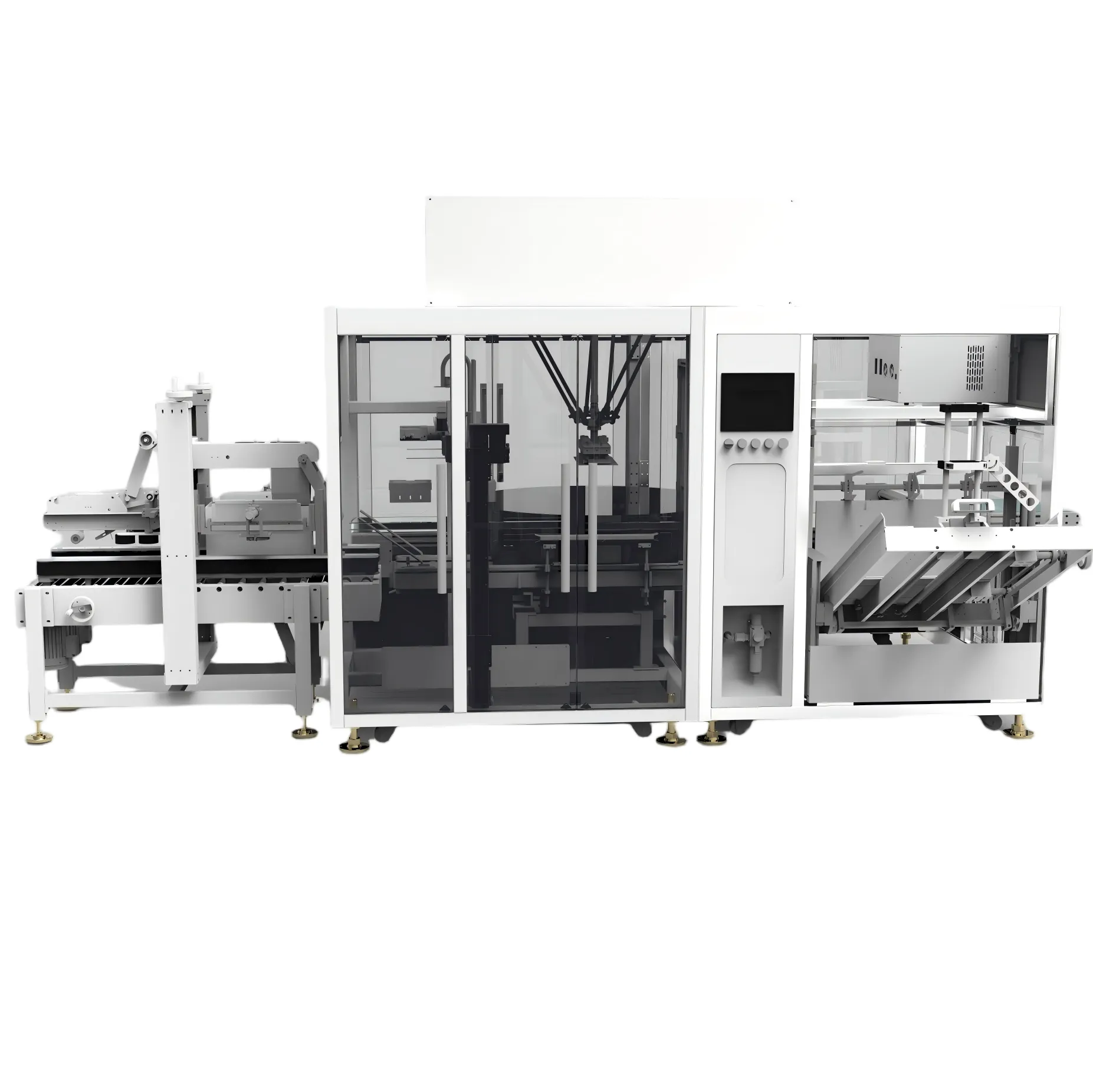
Robot movement and high-speed pick-and-place operations
Conveyor infeed and discharge points
Crushing, shearing and trapping areas
Rotating or reciprocating mechanisms
Pneumatic and vacuum systems
Product jams and manual clearing
Cleaning and format changeovers
Maintenance inside guarded areas
Unexpected startup after interruption
Risk reduction should follow a structured approach: eliminate hazards through design where practical, apply guards and protective devices, and provide instructions for risks that remain.
IEC 60204-1: Electrical Equipment of Machines
IEC 60204-1 applies to the electrical, electronic and programmable electronic equipment of machinery. It addresses areas such as electrical protection, control circuits, protective bonding, emergency stopping and documentation.
For industrial packaging automation, buyers should review the electrical supply, enclosure protection, component specifications, wiring identification, disconnecting devices and compatibility with local plant requirements.
The machine’s voltage, frequency and control-component configuration should be confirmed before production, especially when equipment is being exported.
ISO 13849-1: Safety-Related Control Systems
ISO 13849-1 provides principles for designing safety-related parts of machine control systems. It is relevant to functions such as guard-door monitoring, emergency stopping, safe motion interruption and restart prevention.
The required control-system performance depends on the risk assessment. A standard programmable logic controller should not automatically be assumed to provide the required safety performance unless the complete safety function has been appropriately designed and validated.
Guarding and Interlocking Standards
ISO 14120 covers general requirements for fixed and movable machinery guards, while ISO 14119:2024 addresses the selection and design of interlocking devices associated with guards.
For a robotic packing line, guarding should prevent access to hazardous movement while still allowing practical product feeding, inspection, cleaning and changeover. Opening an interlocked access door should trigger the defined safe response and prevent hazardous restart until the required reset procedure has been completed.
Compliance Checklist for Packing Automation
Before purchasing or commissioning an automatic packing system, businesses should evaluate the following areas.
| Compliance Area | What Should Be Confirmed |
|---|
| Risk assessment | Hazards, operating modes, risk levels and risk-reduction measures are documented |
| Machine guarding | Fixed and movable guards prevent access to hazardous movement |
| Interlocking | Opening a protected access point produces the required safe machine response |
| Emergency stops | Devices are accessible, clearly identified and integrated into the safety design |
| Electrical safety | Power supply, protection, grounding, wiring and control panels meet project requirements |
| Restart prevention | The machine does not restart unexpectedly after power restoration or guard closure |
| Maintenance safety | Isolation and lockout procedures are defined for electrical, pneumatic and stored energy |
| Operator training | Operators understand startup, shutdown, jam clearing, cleaning and emergency procedures |
| Documentation | Manuals, drawings, parts lists, risk information and maintenance instructions are supplied |
| Acceptance testing | Safety functions and operating sequences are tested before final approval |
For machinery used in the United States, OSHA 29 CFR 1910.212 requires suitable guarding to protect employees from hazards such as points of operation, ingoing nip points and rotating parts. OSHA has also specifically stated that packaging and palletizing machinery must be guarded where moving components can cause bodily injury.
A checklist should not replace a machine-specific risk assessment, but it gives procurement and engineering teams a practical framework for reviewing supplier proposals.
Global and Local Regulations: What Buyers Should Know
International standards such as ISO 12100 and IEC 60204-1 provide a useful technical foundation, but they do not automatically replace national laws or local installation requirements.
The final compliance scope may depend on:
The country where the machine will be installed
Whether the equipment is supplied as a standalone machine or an integrated line
The packaged product and its contact requirements
Whether industrial robots or collaborative robots are included
The factory’s electrical and occupational-safety rules
Hygiene, cleaning and contamination-control requirements
Explosive atmosphere or combustible-dust risks
Local language requirements for labels and manuals
For example, a food packaging automation system may require hygienic construction, cleanable product-contact areas and contamination controls in addition to general machine safety.
A pharmaceutical application may require stricter control of product handling, traceability, cleaning and quality documentation. Tirimi’s pharmaceutical robotic automation solutions can be configured around the product, process and production-line requirements, but the applicable standards should always be confirmed for the specific project.
Staying Updated on Regulatory Changes
Machinery regulations and technical standards continue to evolve. Manufacturers and equipment users should maintain a structured compliance-review process instead of checking requirements only when purchasing a new machine.
Recommended actions include:
Reviewing regulatory updates in target markets
Confirming the latest edition of referenced standards
Recording machine modifications and software changes
Reassessing risk after changing products, speeds or formats
Testing emergency stops, interlocks and safety sensors regularly
Updating operator and maintenance training
Keeping inspection, maintenance and incident records
Consulting qualified safety and compliance specialists when necessary
Machine modification is particularly important. Adding a conveyor, changing a robot gripper, increasing operating speed or integrating new upstream equipment may introduce hazards that were not covered by the original risk assessment.
Conclusion
Compliance for automatic packing machines requires more than checking a list of certificates. It depends on how the machine is designed, guarded, controlled, installed and used within the complete production environment.
Buyers should evaluate risk-assessment documentation, electrical design, safety-related controls, guards, interlocks, operating instructions and acceptance testing before approving an automated packaging system.
Tirimi provides configurable robotic packing workstations for food, pharmaceutical, personal-care, electronics, automotive and other industrial applications. Machine configuration, safety functions and documentation can be discussed according to the packaged product, production capacity, line layout and destination-market requirements.
To receive a project-based recommendation, provide the product dimensions, packaging format, target speed, factory layout, destination country and required safety standards.


 English
  中文
中文